
Vancouver Market - Tracking commercial real estate investment sales across Metro Vancouver — sale prices, cap rates, and $/SF data for apartment, retail, office, land, and development transactions. By David Taylor, SVP at Colliers International Canada.
  • About
  • Listings & Sales
  • Thinking of Selling?
  • Metro Vancouver Commercial Real Estate Market Data
  • Subscribe
Development, Market Research

The Inexorable Upward March of Land Prices

Just ask any developer; it’s becoming increasingly difficult to find sites to build condos or mixed-use developments in the City of Vancouver. Despite the buzz in the media about developers running City Hall, an burgeoning supply of single family land assemblies, and spot rezonings occurring all over the place, the vast majority of rezoning and development activity outside of Downtown Vancouver is presently confined to areas such as the Cambie Corridor and Southeast False Creek (“SEFC”), both of which are near transit and underwent lengthy master planning phases in the past 5-10 years to add moderate density; typically averaging 3.0 FSR or less. 15 of the 40 currently proposed rezoning applications in the City of Vancouver fall within these two areas alone. Furthermore, of the other 16 proposed rezoning applications that are located outside Downtown/Chinatown, none are for condo developments; none! The applications are all for market rental, social housing or institutional uses. Of course, this does not jive with the public perception that Vision Vancouver has granted spot rezonings for condo towers all over town, a view which does have some merit given pre-planning phase approvals for such developments as PCI’s Marine Gateway and Westbank’s Granville and 70th developments in the past few years. Nevertheless, more recent direction shows that the City has definitively pulled on the reins of both area plan policy work and speculative rezoning applications.

Outside of the Downtown, Cambie Corridor and SEFC areas, developers are facing scant opportunities to find land in a City that is becoming entrenched as a predominantly wealthy single family enclave with over 65% of land still dedicated to this lowest form of housing density that existed nearly 100 years ago. While City of Vancouver planning staff have made an attempt under Brian Jackson’s oversight to pursue gentle densification of various neighbourhoods in forms such as stacked townhouses and fee-simple rowhouses; it has been largely met with resistance by neighbourhood groups who, in many cases, oppose even the most benign forms of density that threaten the single-family neighbourhood ideal. Likewise, affordable housing activists have argued that $800K townhouses are not a solution, even in large areas where $2M houses are the only option for home-ownership. The end result is that positive planning processes such as that which commenced for Grandview-Woodlands in 2013 turn into endless community consultation and opportunities for redevelopment are deferred for several years.

In a time where rezoning and the public approval process in general is an increasingly contentious and politically sensitive endeavor, developers are fleeing to land where there is the least risk. And where is that? Pre-zoned land. Certain zoning types have become the primary target for many developers and investors over the past 5 years or so; including:

  • C-2 (mixed-use zoning on various arterials outside downtown)
  • C-3A (mixed-use zoning primarily in the Broadway/Mt. Pleasant areas)
  • RM-8 & RM-9 (new townhouse and 4-storey zones respectively. Marpole only so far)

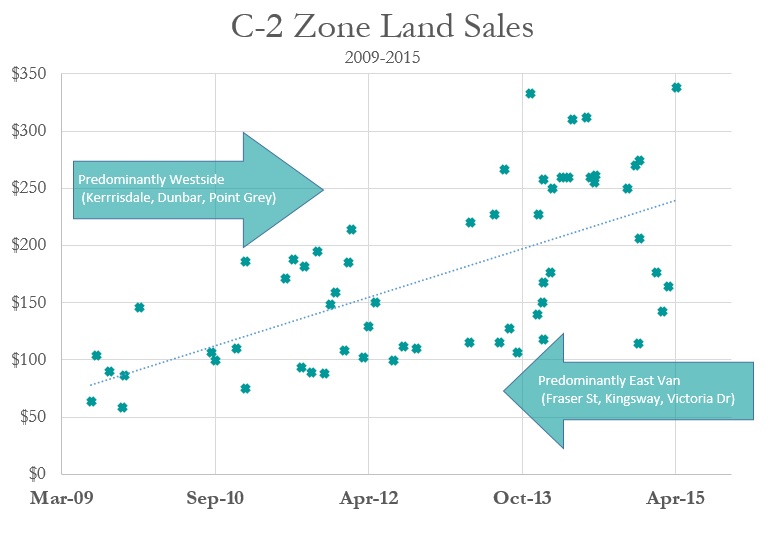
Here is a quick look at sales of C-2 zoned properties in the City of Vancouver to show the effect of the aforementioned increase in demand for pre-zoned land.

For those unfamiliar with C-2 zoning, it is a commercial mixed-use zoning scattered throughout the City’s arterial streets (excluding Downtown). The C-2 zone allows a total density of 2.5 FSR and a total height of 4-storeys. What makes it one of the more sought after zones by developers is that it allows residential above the ground floor, and is found in wealthy established areas such as Dunbar and Kerrisdale, as well as emerging areas like Fraser Street and Kingsway. Existing commercial properties on any sites large enough to accommodate underground parking, and that do not have long-term leases in place are being snapped up all over the City.
C-2 Zone Land SalesThe sales show the difference in values between East Vancouver and the above-mentioned areas of the Westside, which of course support higher condo values and retail lease rates relative to East Van. More apparent however, is the increase in values city-wide. While previously averaging around $125 per buildable SF as recently as 2010, the average has now shot past $200 per SF, with recent trades in Kerrisdale well over $300 per buildable SF, and Main Street trades now being reported as high as $250 per BSF. $300 per BSF is a figure which is only supportable in an exclusive and already wealthy area that can justify condo sales approaching $1,000 per SF. The lack of available sites in these areas helps to create the exclusivity that supports the underlying sales, as opposed to areas like Cambie and SEFC where the areas have been, and still are, being inundated with new condo inventory. Speculation may also be a factor where investors are simply buying existing C-2 zoned income properties and holding them, but this has been less prevalent and is not included in the sales charted above.

The above price trend holds true for the C-3A zone, as well as other zones which allow the developer to proceed with only a development permit and avoid the lengthy rezoning process.

Land values for C-2 zoned properties and in other pre-zoned areas will continue to be in high demand for developers as long as the opportunities for rezoning remain limited as they are now, and as long as the City of Vancouver – both City Hall and it’s citizens, continue to support a future in which the majority of the City’s land area continues to be dedicated to a low-density, exclusive and unaffordable housing type – the single family home. Similar to single family lots, they aren’t really expanding these zones, and as they are redeveloped the supply diminishes while the demand grows stronger.
May 26, 2015by david.taylor@colliers.com
Apartment, Development, Market Research

Market Spotlight: Vancouver Housing Stats

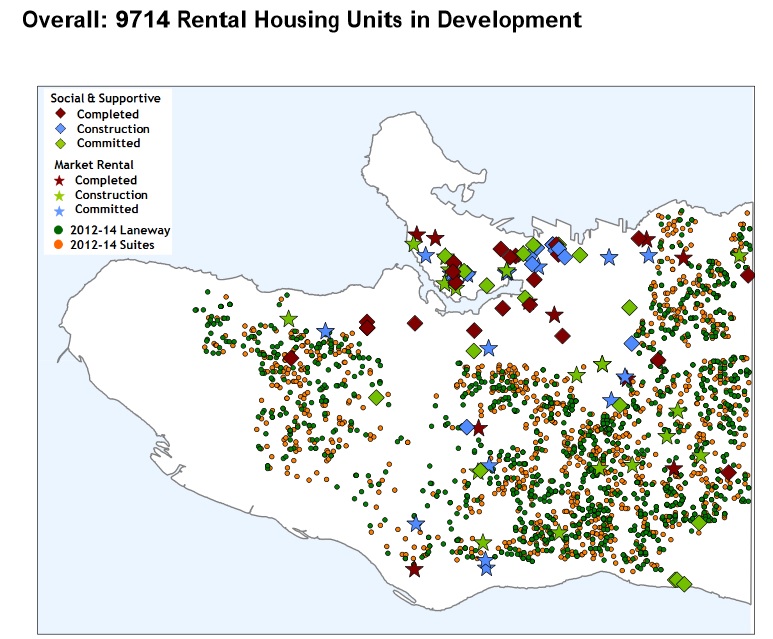
The City of Vancouver will present their third annual Housing and Homelessness Strategy Report Card to council next week. The purpose of the annual report is to track progress of the City’s various initiatives under the Housing and Homelessness Strategy 2012-2021.

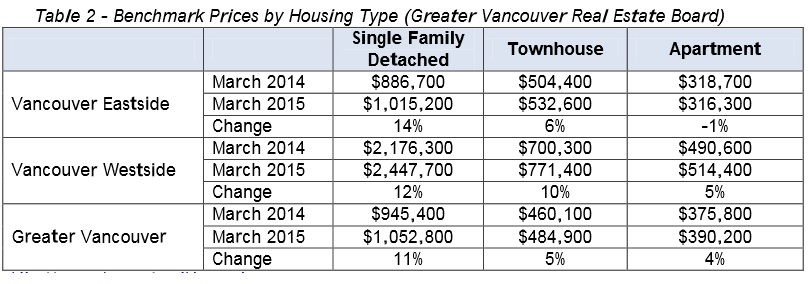
The report is an excellent source of some key housing indicators compiled from CMHC and REBGV, of which several are summarized here:

  • the City of Vancouver had 4,648 dwellings commence construction in 2014 (approximately 25% single family and 75% multi-family units). This rate is close to the 5-year annual average of 4,824.
  • Vacancy rates continued to decrease between 2013 and 2014, both in the city of
    Vancouver (from 1.0% to 0.5%) and regionally (from 1.7% to 1.0%) reflecting
    ongoing population growth and demand for housing
  • Between March 2014 and March 2015, the benchmark  price for a single family
    house increased by 14% on the eastside and 12% on the westside, while the
    benchmark price for condos fell by 1% on the eastside and increased by 5% on
    the westside.
  • 409 units of interim supportive housing were created in 2014 (395 Kingsway, 3475 E. Hastings, 1335 Howe and 1060 Howe)
  • 439 units of permanent supportive housing were created (1134 Burrard, 111 Princess, 2465 Fraser and 951 Boundary)
  • 3,783 secured market rental units have been approved during 2012-2014 (only 407 were actually completed in 2014)

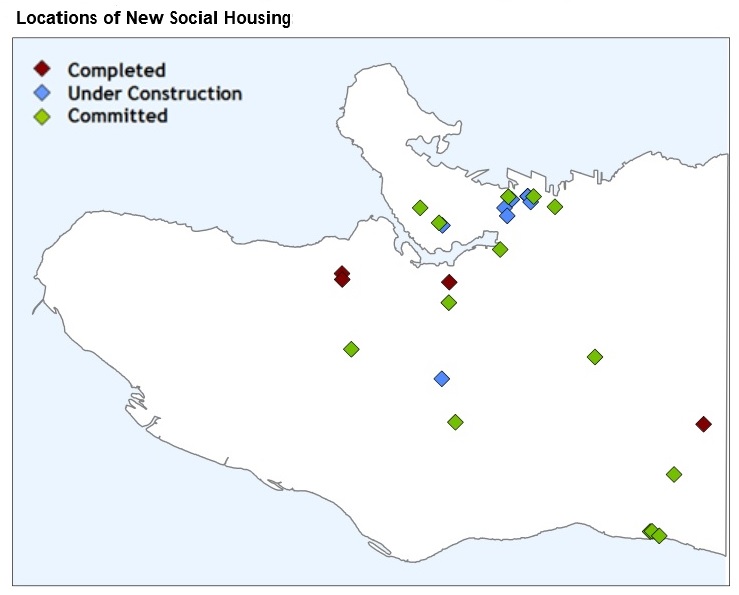
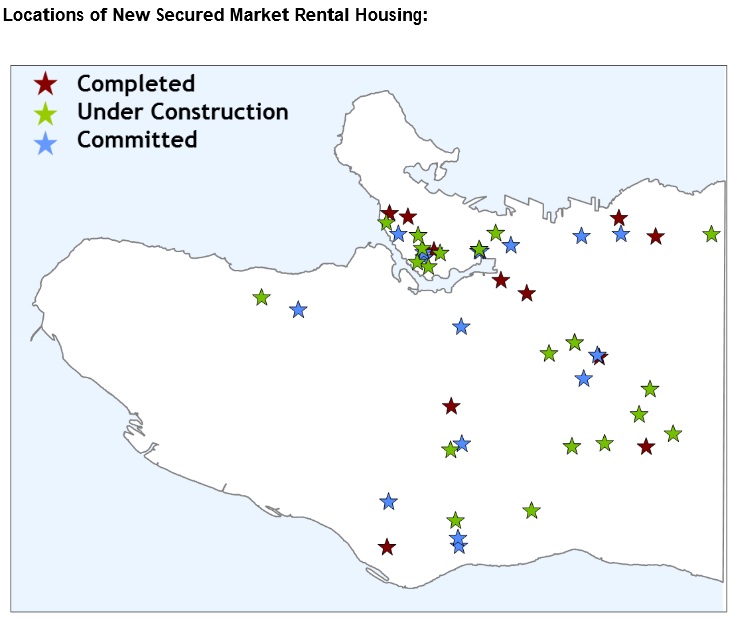
CofV_Housing report_1 CofV_Housing report_2 CofV_Housing report_3

CofV_Housing report_4

May 22, 2015by david.taylor@colliers.com
Investment, Office

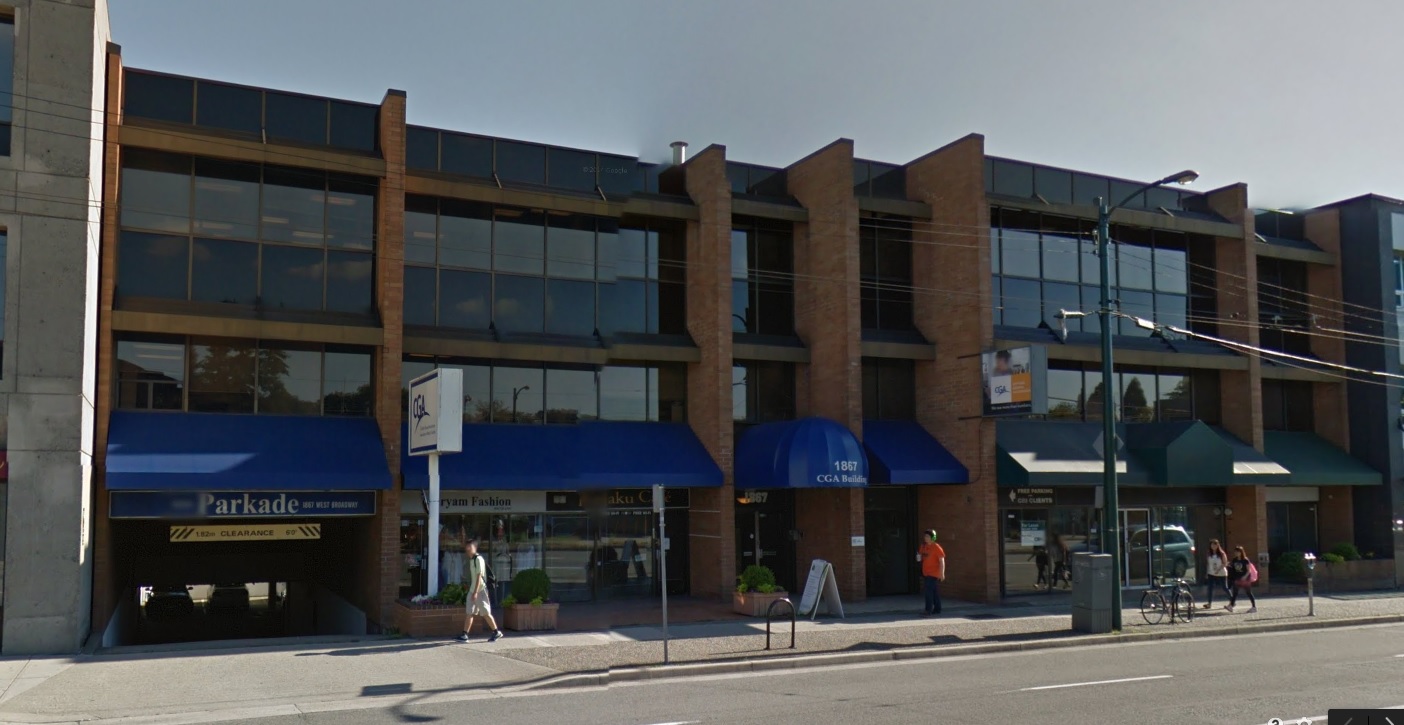
1867 West Broadway Sells in $16.1 Million Deal

1867 West Broadway, a 3-storey B Class concrete office building more commonly known as The CGA Building, has sold for $16,125,000. The 31,000 SF building was owned by the Certified General Accountants Association of B.C., who will vacate it’s 26,000 SF this summer. The site the building is located on is 13,402 SF and is zoned C-3A. The property was listed for sale in late 2014 with no asking price.

The 2nd floor of the building is currently listed for lease at $22.00 per SF.

The purchaser was Austeville Properties who owns the adjacent commercial building. This appears to be a long-term strategic investment as opposed to any kind of redevelopment deal.

1867 West Broadway

March 17, 2015by david.taylor@colliers.com
Development, Market Research

Amid Swift Unit Sales, Cambie Street Land Values Continue Uptick

The Cambie Corridor Plan has been approved for almost four years now and a great deal has taken place within the plan area from 16th to Marine Drive. The end result of five years of planning and development activity is only beginning to be seen with a handful of buildings sprouting up. Up and down the Corridor, numerous land assemblies have occurred, with dozens of rezoning applications at various stages of the process. Eleven sites have now had rezoning enacted; meaning they have been officially approved by the City.

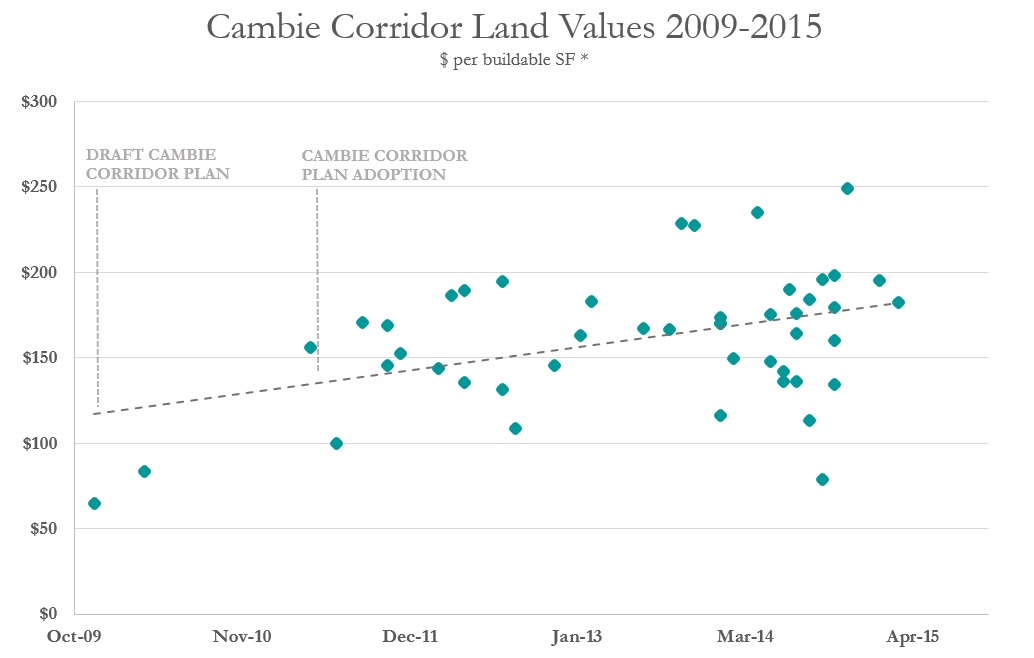
Approximately 28% of the 439 lots in the plan area have now been sold to 42 different developers, and despite a growing list of projects at various stages of construction and approvals, demand from developers continues unabated, particularly for prime locations such as those near Queen Elizabeth Park and Langara Golf Course. The result has been an increase in land values of almost 20% since the Cambie Corridor Plan was adopted by Vancouver City Council in May 2011.

The following chart depicts all of the site/land assembly sales that have taken place within the plan area since 2009.

* based on approved density, or plan maximum where no application exists yet.

* based on approved density, or plan maximum where no application exists yet.

So why are values going up despite an increase in the number of projects coming down the pipeline? Two underlying factors appear to be primary valuation drivers for Cambie land sales, particularly over the past 18 months.

First, a handful of projects have now gone into the marketing phase and have achieved very strong sales in terms of both pricing and sales velocity. In desirable areas of the corridor, woodframe product in selling in the $650-$700 per SF range, and concrete product is selling in the $775-$825 per SF range. Clearly there is a market for new condo product anywhere on the Westside of Vancouver, and Cambie’s accessibility and proximity to transit, parks and schools appeals to many buyers. Developers such as Mosaic Homes and Intergulf have been able to capitalize on this demand.

Secondly, the Cambie Corridor Plan facilitates a relatively straightforward rezoning process that is difficult to find elsewhere in the City. Opportunities for densification in other areas of Vancouver are now almost entirely limited to commercial strips such as Broadway with existing zoning for mixed-use multifamily. With public pushback to other planning efforts in such areas as Grandview-Woodlands where public consultation is being prolonged at the behest of vocal community organizations, developers are forced to concentrate their efforts to the path of least resistance. The Marpole Community Plan was also approved in 2014, though is far less ambitious than Cambie, partially as a result of public opposition, and will result in far fewer rezoning applications and developments.

With a dearth in supply of new sites for development elsewhere in the City of Vancouver, Cambie Street land values will likely continue its steady upward march so long as attendant condo demand continues to be strong.

March 14, 2015by david.taylor@colliers.com
Investment, Market Research

Top Metro Vancouver Commercial Properties: 2015

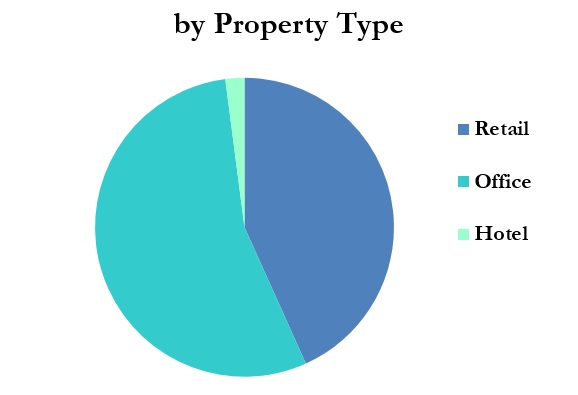
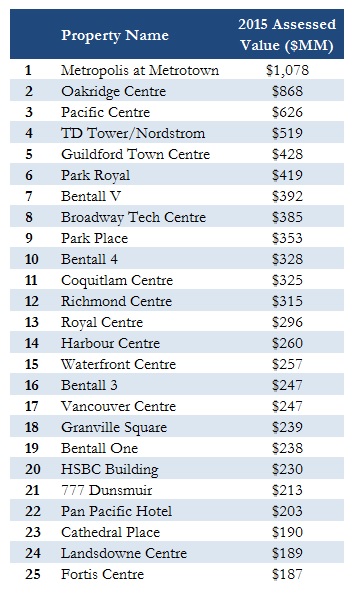
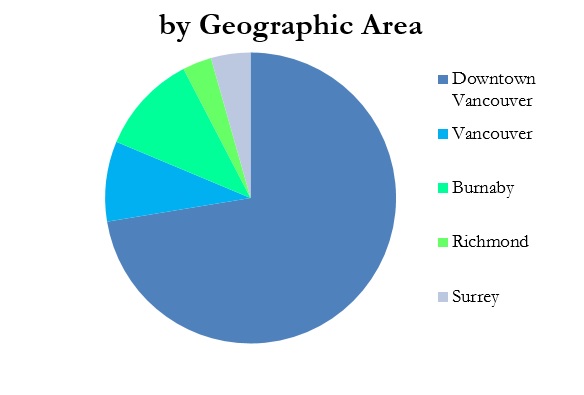
Here is a summary of Metro Vancouver’s most valuable commercial real estate assets. The summary is based on a survey of the top 25 commercial properties ranked by the 2015 tax assessment value. While assessed values don’t neccesarily reflect market values, this analysis provides a fairly accurate snapshot of our city’s most valuable assets:

2015 Assessment ValuesA few observations:

  • Metrotopolis at Metrotown continues to hold its rank as by far Metro Vancouver’s most valuable commercial property, as it has for the last decade. The nearly 1.8M sq ft shopping centre is now assessed at over $1 Billion. This value does not include the adjacent office towers which would likely add another $200 Million, also owned by Caisse de depot, which is Quebec’s largest pension fund manager.
  • The redevelopment of Sears into Nordstrom significantly bolstered its assessment value. Including the office towers, Pacific Centre is now valued at over $1 Billion.
  • Renovations and improvements at aging regional shopping centres including Park Royal and Guildford Town Centre bolstered values significantly.
  • Oakridge Centre’s value had a large increase likely based on it’s 2014 rezoning for over 2,000 residential units.
  • Langara Gardens and Landsdowne Centre both fell off this list, but will likely return in the near future. Both properties are slated for redevelopment. Landsdowne in particular is speculated to have significant redevelopment value.
  • Pension funds control the vast majority of these larger core/trophy assets. (77% to be exact)
  • A group of 6 pension fund managers (some in partnership) control well over 50% of the top 25.
  • While the top 3 are super regional shopping centres, 15 of the top 25 are Downtown office towers.

2015 Assessment_Tbl1 2015 Assessment_Tbl2 2015 Assessment_Tbl3


February 25, 2015by david.taylor@colliers.com
Page 40 of 79« First...102030«39404142»506070...Last »

Thinking of selling?

I track every commercial sale in Metro Vancouver. If you're wondering what your property is worth, I can give you an informed view.

Get an Opinion of Value

David Taylor · Colliers · 604-761-7044

Search the Site

Categories

  • Apartment
  • Condo
  • Development
  • For Sale
  • Hotel
  • Investment
  • Land
  • Market Research
  • Office
  • Rental
  • Retail
  • SOLD


David Taylor Personal Real Estate Corporation

Colliers International

DT

David Taylor

Senior Vice President, Colliers Canada

David Taylor is a Senior Vice President at Colliers International in Vancouver, BC, specializing in the sale of commercial real estate across Metro Vancouver. He has sold over $1.7 Billion in office buildings, retail properties, apartment buildings and development land since 2004.

Vancouver Market chronicles investment and development activity in Metro Vancouver, including sale prices, cap rates, $/SF metrics, and market context for commercial real estate transactions.

© 2019 Copyright  |  All Rights Reserved