By Paul Brent
It is likely not news to any commercial real estate industry veteran, but Montreal, Toronto and Vancouver are expensive places to do business when it comes to taxes.
A recent study from the Real Property Association of Canada (REALpac) confirms that fact, finding those three cities continue to sport the highest commercial to residential tax ratios in the country. The trio all have commercial to residential tax ratios higher than 4:1, while the average tax ratio for all Canadian municipalities was 2.79.
However, there is some good news in the report. Toronto’s commercial to residential tax ratio continues its slow but steady decline over the 11 years REALpac has been keeping track. The ratio declined to 4.01 from 4.07 a year ago. That’s part of the city’s deliberate effort to cut commercial taxes and reverse the exodus of business to the suburbs. Its goal by the end of the decade is to trim its commercial to residential tax ratio to 2.5.
In contrast, the study found Montreal’s ratio increased for the 10th consecutive year, even though there were decreases in both commercial and residential rates over the past two years. In fact, Montreal’s …read more
Source:: RENX
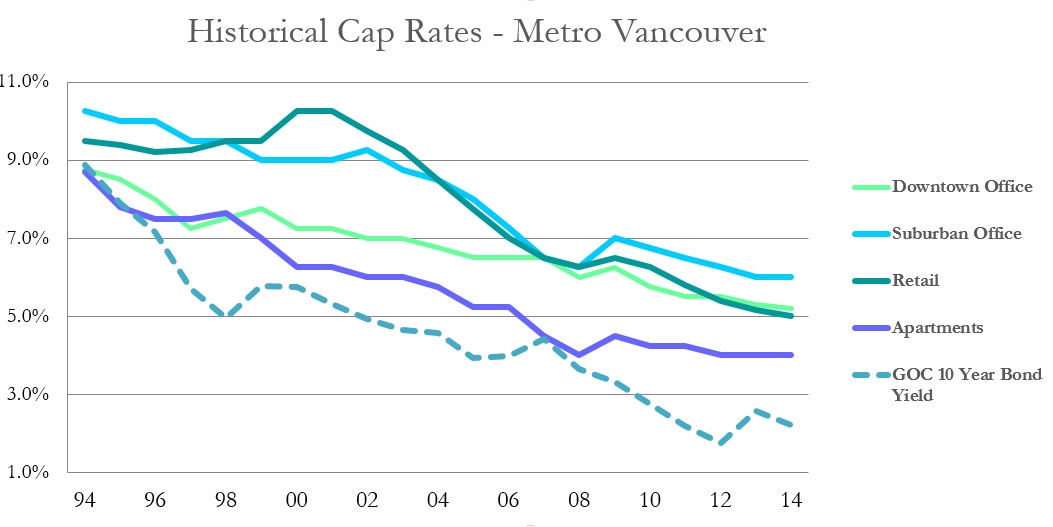
Here is an update to a graph that has been posted here many times previously. Cap rates are continuing a downward or flat trend across most asset classes amid a continued influx of capital and a continued environment of relatively cheap debt and low interest rates.
Suburban office buildings appear to be the one exception in mid-2014, likely reflecting worsening leasing fundamentals and increasing vacancy in many areas such as Burnaby. While there doesn’t appear to be much room for continued compression in the other asset classes, Vancouver tends to be a market that defies logic.
What do you think? Where do you see capitalization rates trending as we finish 2014 and enter 2015….
[poll id=”6″]
By John Clark
The asking price isn’t being disclosed. The Vancouver Sun reported the property’s assessed value is $89.9 million.
But assessed value is a measure of the value of the real estate on which the building rests, as well as the building itself. This does not take into account the value of the business operating on the premises.
These are unrelated – at least in theory. In practice, they often become quite tangled, and not just in the tourism and hospitality sector. This entanglement is often accidental. Sometimes it’s deliberate – a subtle exercise in turning a blind eye some owners may believe will serve their tax planning objectives. Trying to shave dollars from one tax bill, however, may just end up costing you more down the road and leave you painted into a corner.
But even with the best of intentions, distinguishing real estate from business value can be a challenging valuation scenario.
When a hotel isn’t just a hotel
Take a hotel. A sale will typically include all the chattels – furniture, fixtures and equipment – plus the expectation on the part of the buyer that they have …read more
Source: RENX
12-unit Gleneagles townhouse project proposed in West Vancouver
A new proposal has surfaced for the parking lot next to Waterfront Station.
The redesigned project includes a 26-storey, 416,000 SF office tower, shaped like a tree, cantilevered over the existing station building.
Architect: James Cheng
Details: https://bit.ly/46aUB0W