Vancouver Market - Tracking commercial real estate investment sales across Metro Vancouver — sale prices, cap rates, and $/SF data for apartment, retail, office, land, and development transactions. By David Taylor, SVP at Colliers International Canada.
  • About
  • Listings & Sales
  • Metro Vancouver Commercial Real Estate Market Data
  • Subscribe
Development, Market Research

How Burnaby is Building More Highrises than Vancouver (…Way More)

While the City of Vancouver grapples with worsening housing affordability conditions, increasingly contentious area plans, and an excruciatingly slow planning process for even modest density increases, Burnaby is quietly going through what is likely one of the most dramatic suburban transformations in the history Metro Vancouver, if not Canada.

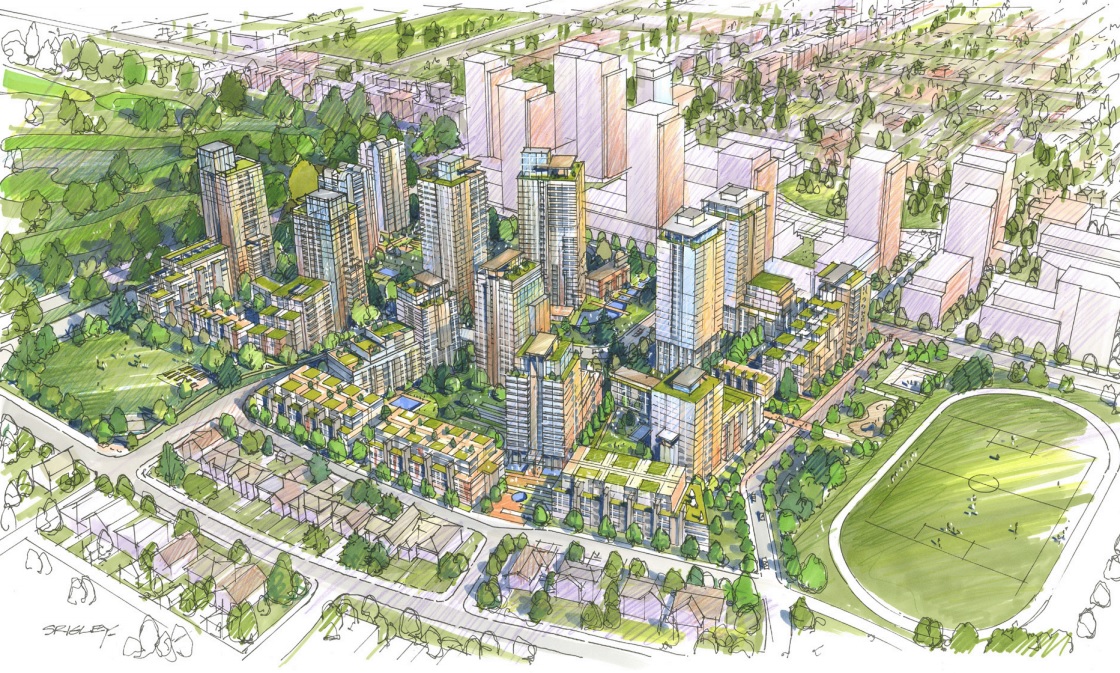
Most people have only really begun to take notice more recently with higher and higher towers starting to pop up in Metrotown and now Brentwood. With a strong condo market fuelling demand for new towers near transit, most of Vancouver’s large developers have been active securing sites in Burnaby in the last several years. While the rezoning applications tend not to attract as much attention as those high profile projects in Downtown Vancouver, the magnitude of activity can’t be ignored, particularly when one ponders the scale of projects like Shape Properties’ recently approved Lougheed Town Centre.

How did Burnaby become a hotbed of highrise construction at a scale that dwarfs even the City of Vancouver? You have to go back a few years to understand how the plans were put in place.

The City of Burnaby put plans in place several years ago to concentrate growth in and near major rapid transit (Skytrain) nodes, particularly in four town centre areas they identified as follows:

  • Metrotown
  • Brentwood
  • Lougheed
  • Edmonds

Furtheremore, unlike homeowners in Vancouver that have been increasingly vocal against even midrise developments, towers in Burnaby have faced less public opposition during rezoning, in part due to the fact that many highrises are being being built in former industrial areas that are being lost to residential, or in areas that are primarily occupied by older rundown apartments where tenants have, seemingly, less influence with the City than single family homeowners.

So far, about 30 highrise towers have been built in these four town centre areas (including 2 office towers), primarily in Metrotown, where projects such as Sovereign by Bosa – a 45-storey hotel and condo tower, and Metroplace by Intracorp – a condo tower near the Metrotown Skytrain station, have each taken advantage of sizeable density increases per the Metrotown Town Centre plan. The sales velocity and pricing of each new development spurs even greater interest for new projects and generates more and more rezoning applications. Land speculation is now commonplace, particularly in more mature areas such as Metrotown.

The City of Burnaby’s willingness to allow fairly substantial density on previously underutilized parcels of land previously dedicated to commercial and industrial use has vaulted Burnaby far ahead of any area in Metro Vancouver in terms of highrise construction. Shape Properties’ two mall sites: Brentwood and Lougheed, are the largest and most well known, but others such as Onni’s Gilmore Station (rumored to include BC’s new tallest tower) and Concord’s Brentwood projects are massive themselves and in terms of height and scale, tower over Vancouver’s most ambitious plans such as the recently scaled back Oakridge.

A review of current and forthcoming developments in the City of Burnaby shows over 100 highrises in various stages of development (under application or construction), almost all of them intended for residential condos, with a handful of commercial office towers usually required on the larger scale developments to preserve job space. A few stats show the scale of this wave of development in Burnaby:

  • 106 highrises under development (compared to 68 in the City of Van)
  • 47 highrises of 40-storeys or more (compared 13 in the City of Van)
  • Over 30,000 units under development (excluding lowrise and townhouse units)

Here is a breakdown of all of this activity, by each area of Burnaby:

[table id=20 /]

[table id=21 /]

[table id=22 /]

[table id=23 /]

The above floor & unit counts are best estimates unless otherwise confirmed in City of Burnaby planning/rezoning application documents.

It is anticipated that there will be more rezoning applications forthcoming in the near future, particularly as the Town Centre Plans are further refined; however, it can be argued that the majority of the most central and logical development sites have now been secured by developers. With a very active presales market and continued upward trajectory of condo prices, it can be anticipated that land costs will continue to increase for these Burnaby tower sites in the future, with areas such as Port Moody and Coquitlam seeking to catch some of the spillover of this growth in conjunction with the 2017 completion of the Evergreen Line.

With the height and scale of these projects in Burnaby, it will be interesting to see what, if any response the City of Vancouver has while it struggles to create even modest height and density in increasingly expensive and largely unaffordable areas.

For the record, I am not espousing the virtues of density as the primary means of increasing affordability. In fact, if Burnaby is behind in an area, it is in the creation of new rental units for which there is currently no coherent or substantive policy. This, in part, has helped the viability of several projects since rental replacement is not a requirement like it is in other municipalities. The City of Vancouver has been more proactive in the provision of affordable housing which has hopefully had at least a moderate impact in terms of affordability.

March 18, 2016by david.taylor@colliers.com
Apartment, Development, Market Research

As Affordability Worsens, Municipalities Taking Differing Approaches

While the City of Vancouver is most often the focus of debate and discussion surrounding the current housing affordability crisis, development pressures are now forcing other municipalities to engage in research and analysis on the issue. Recent public backlash related to the redevelopment of older low-rise apartment buildings has forced staff and council in many Metro Vancouver cities to spend time reviewing the issues.

The Councils of both City of Burnaby and the District of North Vancouver (“DNV”) received reports in the past week from their respective planning departments on issues surrounding housing affordability. In both cases, the reports were prepared primarily for information purposes only and will not immediately result in policy changes; however, the increasing dialogue at the municipal level is sure to have an impact on planning and rezoning policies in these and other municipalities in the near future. Both Burnaby and DNV are grappling with the impending redevelopment under new OCPs that have targeted older apartment buildings in “town centre” areas, though they appear to have differing perspectives on what can actually be done at the municipal level.

Suburban municipalities are well behind the City of Vancouver which was forced to take more severe measures to protect rental housing stock after development pressure in the 80’s and 90’s. Likewise the City of Van has been more progressive on devising and implementing rental incentive policies, to varying degrees of success.

As both single family and condo values increase throughout Metro Vancouver, redevelopment pressures are now mounting in many areas and citizens throughout Metro Vancouver are urging governments to take a harder look at housing affordability. Even sleepy Maple Ridge is feeling pressure on the rental market.

Below is a brief summary of the two reports that went to each City Council with specific focus on the issues identified in each municipality and potential policy implications (or lack thereof):

City of Burnaby – Growth Management and Housing Policies in Burnaby (Nov 4, 2015)

Purpose of Report

“to place the City’s approach to the management of growth within the context of housing policy and demand, tenure and affordability. This report outlines the City’s policy framework for managing growth; reviews the roles and responsibilities of local and senior levels of government in the provision of housing and housing affordability; highlights the City’s legislative role and ability to improve the range of market and non-market  housing opportunities and affordability levels; and discusses the constraints faced by local governments to directly provide or influence the supply and/or affordability of housing.

This report has been prepared in response to observations and concerns received by the City regarding new developments within the Town Centre…where existing rental housing sites nearing the end of their building life-cycle have been advanced for redevelopment”.

Here is a recent news clip about a project on Silver Avenue:

Snapshot of Burnaby’s Rental Housing Market

  • One third of Burnaby’s dwelling units are rental (32,000 of 96,000)
  • 2nd largest rental market (after City of Van – 55,800 units)
  • Current apartment vacancy rate of under 1%
  • Most town centre areas have buildings from 50s/60s – nearing end of life
  • Land costs largely preventing new rental construction despite demand

Role of Municipality and Burnaby Policies to Date

  • Rental Conversion Control Policy (1972) -can’t convert rental to strata
  • Density Bonus Policy (1997) – allows rezoning, 20% of CAC to non-market
  • Tenant Assistance Policy (2015) – requires tenant assistance exceeding RTA

Overall, the City indicates that 7,900 Non-market units have been developed in 154 developments.

Constraints to Addressing Affordable Rental Housing

  • City cannot impose a moratorium on demolition of existing apartments
  • A “Standard of Maintenance Bylaw” imposed on existing apartment owners would not have the desired effect of increasing supply or addressing affordable rents
  • City is looking at ways to build rental housing directly, but needs support of other levels of gov’t
  • A requirement for rental replacement would impair feasibility of new projects

The report points out that it is estimated that 25% of all new strata are rented out, equating to 8,400 rental units in new supply.

CONCLUSION

The general conclusion of the report is that any policy in the near-term that would slow the redevelopment in town centre areas would have an overall worse impact on housing affordability by suppressing the supply of new units. The report does acknowledge the attendant impact development is having on older apartment stock, but infers that this is necessary to generate housing supply and new rental (through strata investment)

While the discussion isn’t likely to end here, it does not appear that there will be any impact on rezoning applications in the near future. The City of Burnaby is effectively keeping things status quo for now.

District of North Vancouver – Rental and Affordable Housing Green Paper (Nov 2, 2015)

Purpose of Report

“This report…provides an overview of the housing situation in the District and identifies the key issues for rental and affordable housing. Through the implementation of the Official Community Plan and other relevant policies, and the administration of the land development application and review process the District has an opportunity to advance key objectives towards protecting existing rental stock and creating more affordable housing.

Emerging developer interest in redeveloping existing rental, and older fractional interest multi-family residential properties in the District has prompted concerns from Council over the potential loss of older, more affordable purpose built rental and low end market ownership units and the potential displacement of lower to moderate income residents.”

Snapshot of Rental Housing in District of North Van

  • 9,020 total market rental units
  • 4,500 estimated secondary suites
  • 850 strata rental units
  • $1,209 average rent per month

Key Housing Challenges in the District of North Van

  • High housing prices relative to income
  • Aging purpose built rental housing stock and lack of renewal
  • Almost 90% of 1,269 rental units built before 1980
  • Existing rental at risk for redevelopment (over half of stock in town centre areas)
  • Displacement of tenants an issue through new market rents
  • Apartment vacancy rate is under 1%
  • Lack of options for rental for families, students and seniors
  • Expiring operating agreements for co-ops and non-profit societies
  • Growing homeless population

Potential Tools to Consider

Below is an outline of some of the tools DNV planning staff are examining and considering to address some of the issues above.

  • Update Standards of Maintenance Bylaw to improve effectiveness
  • Establishment of DNV Housing Corporation to acquire and operate rental
  • Amending 1:1 rental replacement to acquire fewer but more affordable units
  • Phasing development to replace existing rental
  • Create a rent bank
  • Priority processing and potential density bonus for rental applications
  • More affordable housing incentives in rezoning including CACs to fund
  • More affordable ground oriented housing / market value restrictions

CONCLUSION

The District of North Van appears to be taking these issues quite seriously and in fact staff has indicated that they will not consider new applications involving rental housing until these issues are more thoroughly explored.

This may lead to a new rental and affordable housing policy that could potentially impact future rezoning applications. Time will tell which measures actually get implemented. In the short term, the above analysis will almost certainly have the negative effect of slowing rezoning and development applications.


As older rental stock continues to age through Metro Vancouver, we’re likely to see more municipalities exploring ways to address housing affordability, primarily on the rental side.

November 10, 2015by david.taylor@colliers.com
Development

Construction Update: Trump Tower

The 63-storey Trump Tower Vancouver is nearing completion. The 63-storey, 218 unit condo and 147 hotel room tower is expected to open in summer 2016.

IMG_8339
Photo courtesy 604 City on Flickr

October 19, 2015by david.taylor@colliers.com
Development

FOR SALE: 1080 Barclay Street, Vancouver

1080 Barclay 1080 Barclay_1Contact us for further details.

August 18, 2015by david.taylor@colliers.com
Development

FOR SALE: 1070 Barclay Street, Vancouver

1070 Barclay_11070 Barclay_2Contact us for further info.

August 12, 2015by david.taylor@colliers.com
Page 36 of 76« First...102030«35363738»405060...Last »

Search the Site

Categories

  • Apartment
  • Condo
  • Development
  • For Sale
  • Hotel
  • Investment
  • Land
  • Market Research
  • Office
  • Rental
  • Retail
  • SOLD


David Taylor Personal Real Estate Corporation

Colliers International

DT

David Taylor

Senior Vice President, Colliers Canada

David Taylor is a Senior Vice President at Colliers International in Vancouver, BC, specializing in the sale of commercial real estate across Metro Vancouver. He has sold over $1.7 Billion in office buildings, retail properties, apartment buildings and development land since 2004.

Vancouver Market chronicles investment and development activity in Metro Vancouver, including sale prices, cap rates, $/SF metrics, and market context for commercial real estate transactions.

© 2019 Copyright  |  All Rights Reserved