
The City of Vancouver will consider a recommendation to makes changes to the West End Rezoning Policy regarding social housing requirements.
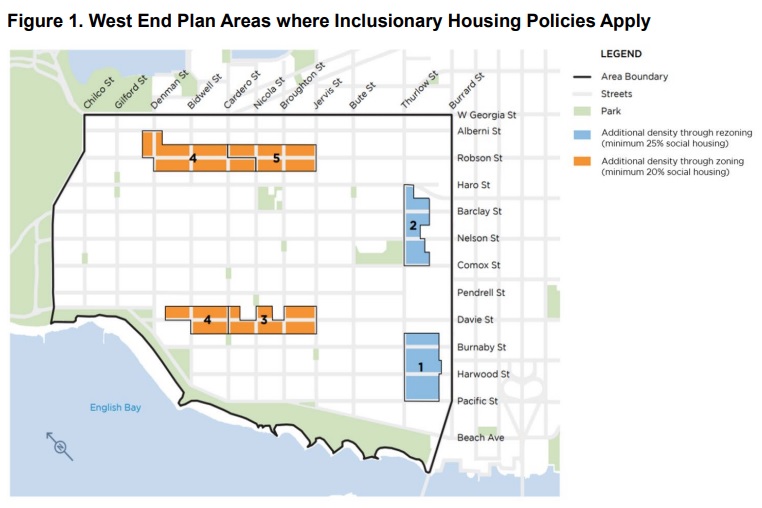
The report indicates the following recommended changes in Areas 1 & 2 of the West End Plan (depicted below):
Reducing the inclusionary social housing requirements 25% of the residential floor area to 20% or one-for-one replacement of the existing rental housing, whichever is greater
Introducing a cash-in-lieu option that reflects the costs for the City to deliver such social housing offsite, including land and construction, which will be determined on a case-by case basis through the rezoning process.
The reduction to the inclusionary social housing requirement is recommended as an interim measure for two years until December 31, 2026, or until adoption of a new Inclusionary Zoning By-law that would supersede this rezoning policy.
Three projects have been approved for rezoning with the 25% social housing but have not yet started construction. These projects would require a new application to be granted the reduction.
City of Coquitlam council has released a report outlining the timing, process and scope of their OCP update.
As with other municipalities, work was already underway on an OCP review as of 2023 before the Provincial legislation changes. Now, the in-progress OCP review has been tweaked to accommodate the new legislation.
Coquitlam’s last full OCP was completed in 2002 and has been updated incrementally through various neighbourhood plans.
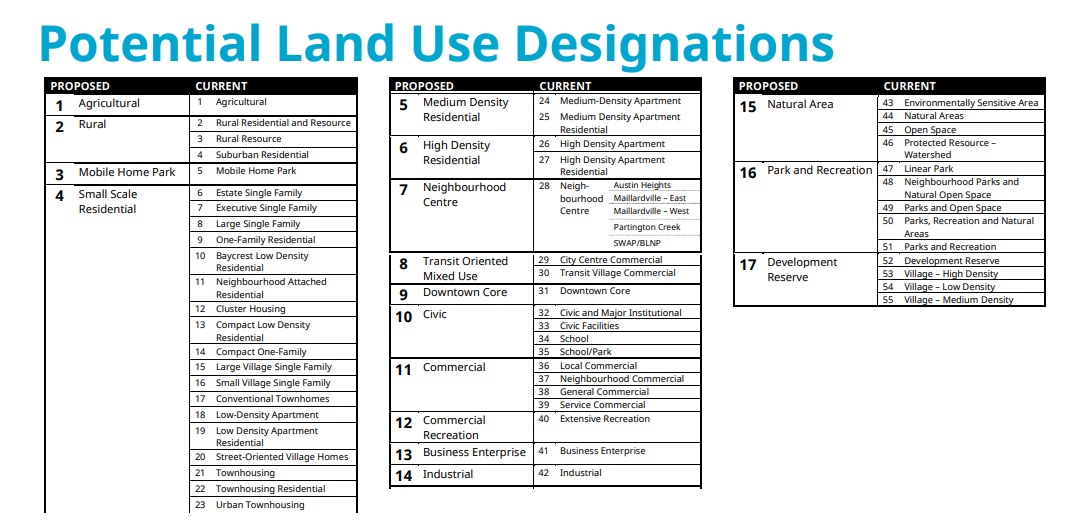
The staff presentation identifies potential land use designations:
Planning staff is now proposing an overhaul of the OCP, streamlining it by consolidating all neighbourhood plans into a single consolidated OCP, with all maps in dedicated schedules.
The report outlines the OCP update project as follows:
The OCP Review project is scheduled for completion in fall 2025, well ahead of the December 31, 2025 deadline for the provincial housing legislation OCP updates. The three high-level phases of the project are:
Prepare (completed): review and analyze existing content to inform and support the overall project;
Update (Summer 2024-Spring 2025): draft the necessary changes and prepare new draft document; and
Adopt (Summer-Fall 2025): bring a draft of the updated OCP forward for consideration and adoption.
City of Burnaby council will meet next week to review a report regarding the City’s OCP that outlines a Draft Land Use Framework for the entire City.
The City had been working on an update to the OCP entitled ‘Burnaby 2050’, since 2022. This is the first time that a draft land use document has been presented to the public showing potential land use for every lot.
The City is also working on a new Zoning Bylaw that will introduce a new “height-based development framework” in which land use designations are based on height (measured in storeys) as opposed to density and Floor Space Ratio (FSR). Details of the new Zoning Bylaw have not yet been released.
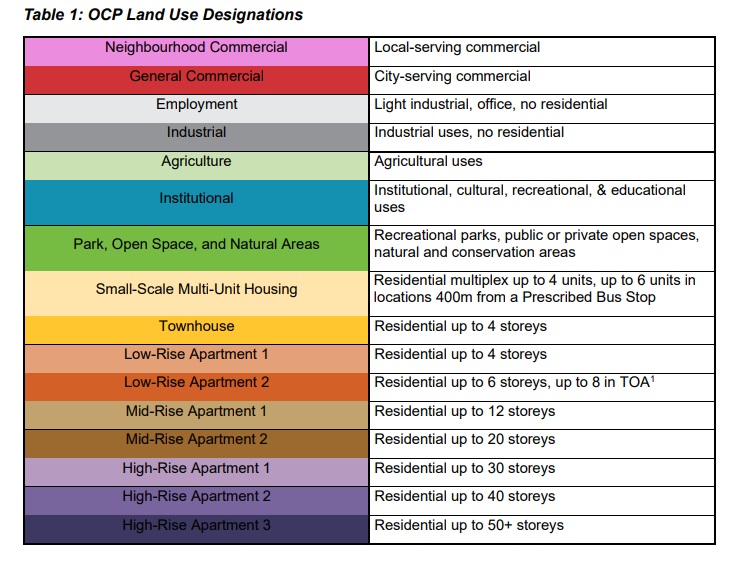
The new Official Community Plan Land Use Framework, and the corresponding Zoning Bylaw Districts are proposed to have seven (7) non-residential designations and nine (9) residential designations, each with a corresponding colour:
The updated draft land use plan accommodates the most recent TOA legislation (which was tabled by Burnaby council for 90 days) as well as upcoming Royal Oak and Edmonds Area Plans.
In addition to the land use designations, the City will be implementing a series of “Policy Overlays” to certain areas, blocks and lots. Examples of proposed Policy Overlays include: Rental Tenure, Streamside Development Permit Areas, Statutory Rights-of-Way, and Special Study Areas.
Community Benefit Density Bonus
The City has also outlined a new, modified density bonus program:
The OCP land use designations describe intended heights of buildings; however, a parcel may be eligible for additional height, beyond what is considered “additional supported height”, in exchange for provision of an on-site amenity or cash-in-lieu of an on-site amenity (“Community Benefit Density Bonus”), so long as it does not exceed the permitted height of the next most permissive land use category (if there is one).
Density bonusing opportunities are identified for the High-Rise Apartment 1, 2, and 3 designations, and may be considered in the Low-Rise 1, Low-Rise 2, Midrise 1, and Midrise 2 designations subject to City policy and bylaws.
Similar to the “additional supported height” scenarios, for residentially designated properties, additional height may be supportable so long as it does not exceed the permitted height of the next most permissive land use category (if there is one).
The draft land use map will be brought forward for public engagement in September 2024, with a report back to Council in late 2024 and an expectation of a final version in early 2025.
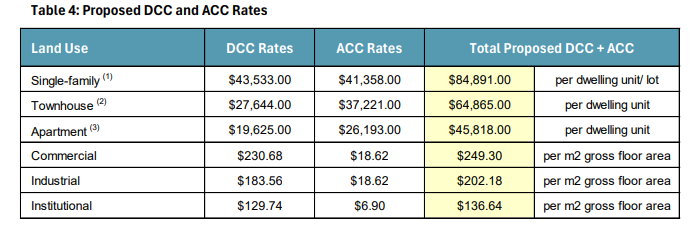
The District of North Vancouver has released a report outlining their updated development charges as part of their compliance with Provincial legislation. The DNV’s last major update to DCC’s was in 2018, and a further update was underway in 2023 when Bill 46 required new development financing tools. DCC’s were last adjusted for inflation in the DNV in 2022.
The District is updating it’s rates to be based on a per dwelling unit basis, as opposed to the previous per sq metre.
Here are the proposed DCC and ACC rates:
The DNV notes in its report: “As required by the new provincial housing legislation, a more fulsome review of growth will be completed over the next year, and development charges will be updated again in the fall of 2025.”
The City of Vancouver has released a report outlining proposed by-laws to implement rezoning policy under the Provincial Legislation: Bill 47 for transit oriented areas.
The proposed rezoning policy includes the following:
Land Use Framework: The rezoning policy generally follows the tiers identified in the TOA Policy Manual for heights and densities, with some minor adjustments:
For Tier 1 (200m, 20-storey inner ring), the density has been increased from a Floor Space Ratio (FSR) of 5.0 to 5.5 FSR
This also applies to certain RM-zoned properties in the Commercial-Broadway Station Precinct of the Grandview-Woodland Community Plan that are up to 400 m from the Station.
In all tiers, the policy will also support applications for low-rise market rental developments of 4- or 5-storeys, and 6-storeys with 20% below-market rental, which could be rezoned directly into existing rental residential (RR) district schedules rather than custom zones for each site.
Ground floor commercial required where it aligns with existing area plans, or on arterial sites within 400 meters of a station, otherwise at option of developer.
Tenure & Affordability: Proposals seeking to maximize height and density in all Tiers (20-storey, 12-storey and 8-storey rings), will be required to:
Secure 100% as rental, with a minimum 20% as below-market rental; or
Deliver 30% as “turn-key” social housing.
Tenant Protection: The same enhanced tenant stability and protection policies approved for the Broadway Plan are included in the TOA Rezoning Policy.
Heritage: Properties may be limited in historic areas or for properties with an HRA. 10% additional density available for sites that retain, conserve or designate heritage on site.
Infrastructure: upgrades may be required and can be confirmed and/or implemented during the rezoning process.
Process: A rezoning enquiry will be strongly encouraged prior to submission of a formal rezoning application.
CACs: Residential rezonings opting to pursue TOA heights and densities enabled under the TOA rezoning policy would be expected to provide the required affordable housing (social or below-market rental) to achieve the identified height and/or floor space. For these rezonings, no additional cash CAC contribution or proforma review will be required as staff are recommending a CAC exemption for these inclusionary housing projects.
First Capital REIT --> Choice Properties REIT and Kingsett Capital are teaming up to acquire the Canadian real estate company in a deal valued at over $9 billion, including assumed debt. Choice Properties will acquire roughly five billion dollars worth of shopping centres, while