Vancouver Market - Tracking commercial real estate investment sales across Metro Vancouver — sale prices, cap rates, and $/SF data for apartment, retail, office, land, and development transactions. By David Taylor, SVP at Colliers International Canada.
  • Home
  • Listings & Sales
  • About
  • Subscribe
  • Metro Vancouver Commercial Real Estate Market Data
Vancouver Market - Tracking commercial real estate investment sales across Metro Vancouver — sale prices, cap rates, and $/SF data for apartment, retail, office, land, and development transactions. By David Taylor, SVP at Colliers International Canada.
Home
Listings & Sales
About
Subscribe
Metro Vancouver Commercial Real Estate Market Data
  • Home
  • Listings & Sales
  • About
  • Subscribe
  • Metro Vancouver Commercial Real Estate Market Data
Development, Market Research

District of North Van Updates CAC Policy

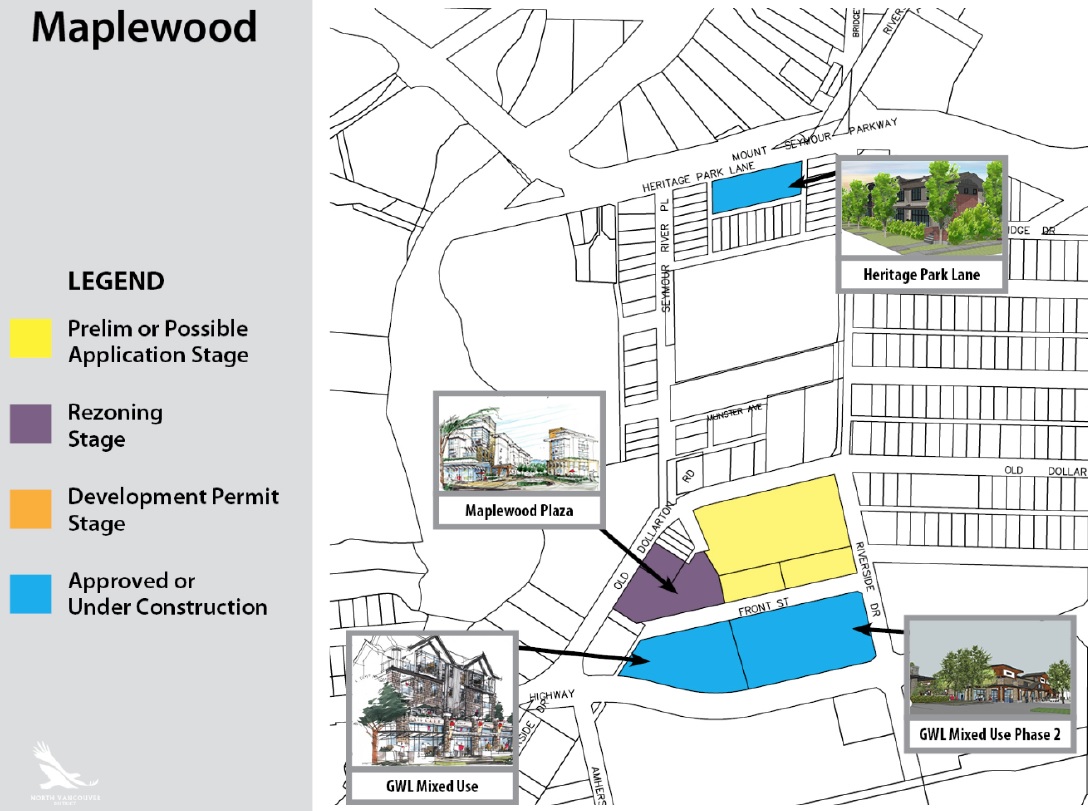
The District of North Vancouver will review a report at council next week that seeks to update the District’s Community Amenity Policy, which has not been reviewed since 2010. The update was required due to increased development pressures and was brought forward partially at the encouragement of the development community. Coriolis Consulting assisted with the review of existing policy.

Here is an excerpt regarding the existing policy:

EXISTING POLICY:

The District of North Vancouver’s existing CAC policy includes two different approaches to
determine the appropriate value of a CAC, depending on the location of the rezoning:

  • In the designated Town and Village Centres (growth centres), the value of the CAC is
    determined through a negotiated approach, equivalent to 75% of the estimated increase in the market value of the property due to the rezoning. The reference to 75% of the increase in property value is to ensure that the CAC does not exceed the
    amount that is financially viable for the development project.
  • Outside the Centres, the CAC value is based on a target fixed rate per square foot of additional residential floorspace approved by the rezoning. Outside of centres, the CAC can be negotiated if the developer thinks the fixed rate is not appropriate or the rezoning exceeds the density identified in the OCP.

Below is an excerpt outlining the recommended changes to be implemented going forward:

“Recommended CAC Approach Outside Centres:

Staffs recommended approach to CACs outside of the Centres is:

1. Establish three separate fixed rate CAC categories outside the Centres with fixed rate
targets as follows:

(a) $6 per square foot (current rate $5) of increased permitted residential gross floor  area for any project with an FSR less than or equal to 0.8 FSR;
(b) $13 per square foot (current rate $5) of increased permitted residential gross floor area for any project with an FSR greater than 0.8 but less than or equal to 1.0 FSR
(c) $20 per square foot (current rate $15) of increased permitted residential gross floor area for any project with an FSR greater than 1.0

2. Negotiate the CAC for the rezoning of any properties that are currently improved with rental housing to take into account the specific details of any rental replacement requirement. The target for negotiations should be at most 75% of the increased value due to the rezoning .

3. Continue to allow negotiated CACs in the specific circumstances currently identified in the District’s policy, but change the target negotiated CAC to be a maximum of 75% of the increased value due to the rezoning, rather than “50% to 75%” of the increased value due to the rezoning as currently written.

Recommended CAC Approach Inside Centres:

Staff’s recommended approach to CACs in the Centres is:

1. Negotiate CACs for major, complex rezonings where it is difficult to determine an appropriate CAC rate in advance of a development application, including:

  • Large sites that have significant land dedications and on-site infrastructure requirements.
  • Sites which include existing rental housing that the District would like to see replaced as part of any redevelopment.
  • Higher density mixed-use sites, such sites in the CRMU 2 and CRMU 3 OCP designations (i.e., mixed-use projects over 1.75 FSR).
  • Highrise residential projects (over 6-storeys in the RES Level 6 designation).
  • Sites identified for a significant on-site amenity.
  • Sites currently zoned for industrial use.
  • Applications that require an OCP amendment.

The target for negotiations should be a maximum of 75% of the increased property value due to the rezoning.

2. Establish new fixed rate area inside the five Centres with a fixed rate target of $20 per square foot (presently negotiated) of additional permitted residential floorspace. The fixed rate areas for inside centres may be found in Schedule 2 of the Draft CAC Policy attached to this report.”

Source: http://app.dnv.org/OpenDocument/Default.aspx?docNum=2796413

January 15, 2016by david.taylor@colliers.com
Apartment, Market Research, Office, Retail

Market Snapshot: 2016 Commercial Assessments

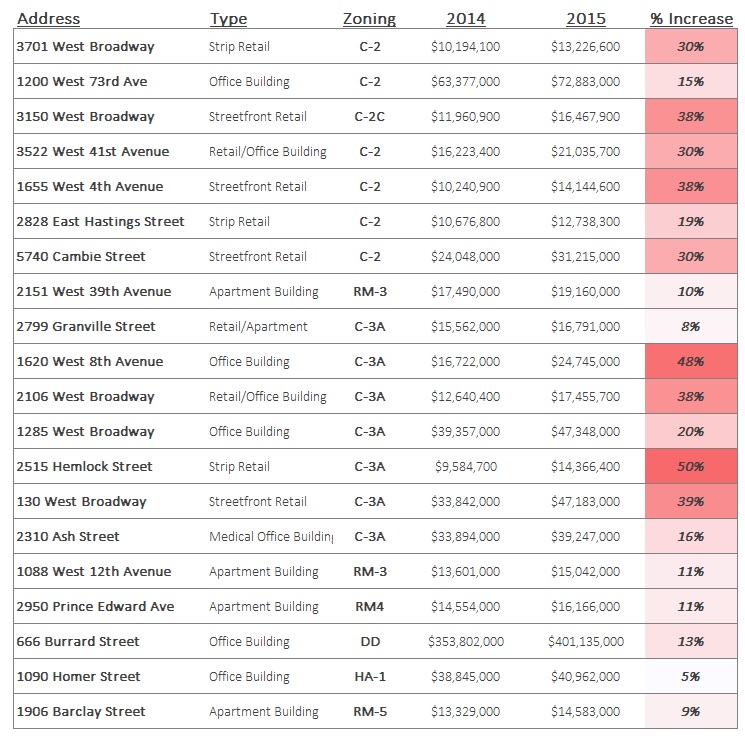
After media reports this week about large assessment increases for residential properties in Vancouver, a quick look at commercial property assessments reveals a similar trend, with rapidly rising values, particularly in certain “hot” areas.

Below is a summary of a random sample of 20 properties within the City of Vancouver with a commercial or multifamily zoning, and the % increase in their respective assessment values this year over last.

(click the chart to view more clearly)

Data source: bcassessment

Data source: BC Assessment

While this analysis is not intended to be exhaustive by any means, it does show some pretty substantial increases in various areas, particularly on or near the Broadway Corridor. Elsewhere, in zones that allow residential development, assessment are rising quickly to reflect sales comparables that are reaching new records on an almost monthly basis. In most cases, it is the land component of the assessments which has risen dramatically in recent years as a result of heightened demand for condo development.

There are likely to be implications for existing commercial tenants in many of these properties as property tax increases flow through to tenants dependent upon their lease structure.

January 5, 2016by david.taylor@colliers.com
Market Research

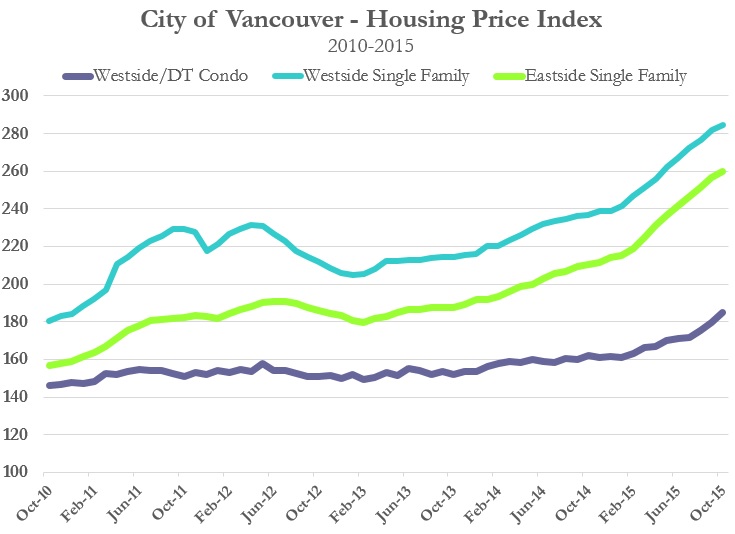
Market Spotlight: City of Van Residential Prices

Here is a snapshot of the current housing price index for the City of Vancouver:

Source: REBGV

Data Source: REBGV

November 19, 2015by david.taylor@colliers.com
Apartment, Development, Market Research

As Affordability Worsens, Municipalities Taking Differing Approaches

While the City of Vancouver is most often the focus of debate and discussion surrounding the current housing affordability crisis, development pressures are now forcing other municipalities to engage in research and analysis on the issue. Recent public backlash related to the redevelopment of older low-rise apartment buildings has forced staff and council in many Metro Vancouver cities to spend time reviewing the issues.

The Councils of both City of Burnaby and the District of North Vancouver (“DNV”) received reports in the past week from their respective planning departments on issues surrounding housing affordability. In both cases, the reports were prepared primarily for information purposes only and will not immediately result in policy changes; however, the increasing dialogue at the municipal level is sure to have an impact on planning and rezoning policies in these and other municipalities in the near future. Both Burnaby and DNV are grappling with the impending redevelopment under new OCPs that have targeted older apartment buildings in “town centre” areas, though they appear to have differing perspectives on what can actually be done at the municipal level.

Suburban municipalities are well behind the City of Vancouver which was forced to take more severe measures to protect rental housing stock after development pressure in the 80’s and 90’s. Likewise the City of Van has been more progressive on devising and implementing rental incentive policies, to varying degrees of success.

As both single family and condo values increase throughout Metro Vancouver, redevelopment pressures are now mounting in many areas and citizens throughout Metro Vancouver are urging governments to take a harder look at housing affordability. Even sleepy Maple Ridge is feeling pressure on the rental market.

Below is a brief summary of the two reports that went to each City Council with specific focus on the issues identified in each municipality and potential policy implications (or lack thereof):

City of Burnaby – Growth Management and Housing Policies in Burnaby (Nov 4, 2015)

Purpose of Report

“to place the City’s approach to the management of growth within the context of housing policy and demand, tenure and affordability. This report outlines the City’s policy framework for managing growth; reviews the roles and responsibilities of local and senior levels of government in the provision of housing and housing affordability; highlights the City’s legislative role and ability to improve the range of market and non-market  housing opportunities and affordability levels; and discusses the constraints faced by local governments to directly provide or influence the supply and/or affordability of housing.

This report has been prepared in response to observations and concerns received by the City regarding new developments within the Town Centre…where existing rental housing sites nearing the end of their building life-cycle have been advanced for redevelopment”.

Here is a recent news clip about a project on Silver Avenue:

Snapshot of Burnaby’s Rental Housing Market

  • One third of Burnaby’s dwelling units are rental (32,000 of 96,000)
  • 2nd largest rental market (after City of Van – 55,800 units)
  • Current apartment vacancy rate of under 1%
  • Most town centre areas have buildings from 50s/60s – nearing end of life
  • Land costs largely preventing new rental construction despite demand

Role of Municipality and Burnaby Policies to Date

  • Rental Conversion Control Policy (1972) -can’t convert rental to strata
  • Density Bonus Policy (1997) – allows rezoning, 20% of CAC to non-market
  • Tenant Assistance Policy (2015) – requires tenant assistance exceeding RTA

Overall, the City indicates that 7,900 Non-market units have been developed in 154 developments.

Constraints to Addressing Affordable Rental Housing

  • City cannot impose a moratorium on demolition of existing apartments
  • A “Standard of Maintenance Bylaw” imposed on existing apartment owners would not have the desired effect of increasing supply or addressing affordable rents
  • City is looking at ways to build rental housing directly, but needs support of other levels of gov’t
  • A requirement for rental replacement would impair feasibility of new projects

The report points out that it is estimated that 25% of all new strata are rented out, equating to 8,400 rental units in new supply.

CONCLUSION

The general conclusion of the report is that any policy in the near-term that would slow the redevelopment in town centre areas would have an overall worse impact on housing affordability by suppressing the supply of new units. The report does acknowledge the attendant impact development is having on older apartment stock, but infers that this is necessary to generate housing supply and new rental (through strata investment)

While the discussion isn’t likely to end here, it does not appear that there will be any impact on rezoning applications in the near future. The City of Burnaby is effectively keeping things status quo for now.

District of North Vancouver – Rental and Affordable Housing Green Paper (Nov 2, 2015)

Purpose of Report

“This report…provides an overview of the housing situation in the District and identifies the key issues for rental and affordable housing. Through the implementation of the Official Community Plan and other relevant policies, and the administration of the land development application and review process the District has an opportunity to advance key objectives towards protecting existing rental stock and creating more affordable housing.

Emerging developer interest in redeveloping existing rental, and older fractional interest multi-family residential properties in the District has prompted concerns from Council over the potential loss of older, more affordable purpose built rental and low end market ownership units and the potential displacement of lower to moderate income residents.”

Snapshot of Rental Housing in District of North Van

  • 9,020 total market rental units
  • 4,500 estimated secondary suites
  • 850 strata rental units
  • $1,209 average rent per month

Key Housing Challenges in the District of North Van

  • High housing prices relative to income
  • Aging purpose built rental housing stock and lack of renewal
  • Almost 90% of 1,269 rental units built before 1980
  • Existing rental at risk for redevelopment (over half of stock in town centre areas)
  • Displacement of tenants an issue through new market rents
  • Apartment vacancy rate is under 1%
  • Lack of options for rental for families, students and seniors
  • Expiring operating agreements for co-ops and non-profit societies
  • Growing homeless population

Potential Tools to Consider

Below is an outline of some of the tools DNV planning staff are examining and considering to address some of the issues above.

  • Update Standards of Maintenance Bylaw to improve effectiveness
  • Establishment of DNV Housing Corporation to acquire and operate rental
  • Amending 1:1 rental replacement to acquire fewer but more affordable units
  • Phasing development to replace existing rental
  • Create a rent bank
  • Priority processing and potential density bonus for rental applications
  • More affordable housing incentives in rezoning including CACs to fund
  • More affordable ground oriented housing / market value restrictions

CONCLUSION

The District of North Van appears to be taking these issues quite seriously and in fact staff has indicated that they will not consider new applications involving rental housing until these issues are more thoroughly explored.

This may lead to a new rental and affordable housing policy that could potentially impact future rezoning applications. Time will tell which measures actually get implemented. In the short term, the above analysis will almost certainly have the negative effect of slowing rezoning and development applications.


As older rental stock continues to age through Metro Vancouver, we’re likely to see more municipalities exploring ways to address housing affordability, primarily on the rental side.


November 10, 2015by david.taylor@colliers.com
Apartment, Development, Market Research

An Idea for Housing Affordability (…Yes, It Involves Density)

There are many significant challenges facing housing affordability in the City of Vancouver. Two of the primary challenges are directly linked to the private market’s inability to build new rental housing. The lack of land available for new rental construction, and the difficulties achieving density sufficient to warrant its construction on most sites are constantly cited by the development community as barriers to new supply.

The City’s existing policies that have sought to incentivize new rental construction include Rental 100. While Rental 100 and its predecessor STIR have been successful in generating almost 4,000 unit approvals (only a few hundred have been built so far), the policy is not without controversy given that it allows what would otherwise be considered spot rezonings were they market condo projects. The City’s recent decision to set limits on rents for new rental projects as a means of promoting “affordability” will only impede the viability of those projects seeking approval under Rental 100.

What about the existing apartment zones?

65% of the City of Vancouver’s land base is dedicated to the lowest form of housing density: single family housing. The remaining 35% is divided among an ever-shrinking base of commercial, industrial, institutional and multi-family. Apartment vacancy rates have hovered below 1% for most of the last decade. In a market where homeownership is increasingly out of reach, it’s time to focus on building more rental where it is already approved, where services and amenities already exist, and most importantly, where renters want to be…RM zones.

With almost 3,000 apartment properties in the City of Vancouver, the vast majority are 3 or 4-storey walkups that were built in the 1950’s and 1960’s. Back then, the City Vancouver’s population was only climbing above 300,000 for the first time and relatively speaking, opportunities to buy land and build an apartment building were relatively plentiful.

Today, these apartments and the zoning that was put in place to permit them, are no longer responsive to the challenges facing today’s housing market.

Let’s focus on specific zones for a moment. The various multi-family zoning types that are scattered throughout the City are tailored primarily toward fairly low density walkup apartment properties. These zones include RM-3, RM-3A, RM-4, RM-4N. These zones generally allow for 1.45 FSR density, basically double that of single family, or about half that of a typical condo development. While these zones and the attendant setbacks, heights and parking were appropriate when they were built, are they appropriate in 2015?

So where are these zones located? They are primarily in established apartment areas such as Kitsilano, Kerrisdale, Marpole, Fairview, Mount Pleasant and Grandview Woodlands. For the purposes of this analysis we have intentionally excluded the already dense West End which is primarily higher density RM-5 zoning.

The City of Vancouver has been loathe to tinker existing apartment zones for many years, particularly as a result of a worrisome trend to convert rental apartments to condos in the 1990’s and early 2000’s, a trend which effectively ceased following the City’s indefinite moratorium on condo conversions for any property containing six units or more (the “rate of change” policy). Certainly these efforts to protect the existing rental stock have protected thousands of tenants that are currently paying far below market rents in central locations.

Currently, City of Vancouver policies prevent building owners or developers from tearing down or doing widespread renovations to existing apartment stock. Condo conversions are understandably deemed to run contrary to the City’s efforts on housing affordability, and so-called “renovictions” are highly publicized in the media as flaunting with tenants’ basic rights.

What is lost in the conversation however, is that the vast majority of buildings in these zones are very old, inefficient lowrise, low-density apartment buildings that no longer meet the needs of the current population.

Some facts regarding the RM-3, RM-3A, RM-4 & RM-4N zones:

  • Total number of Apartment Properties*:          2,011
  • Total land occupied:                                            22,684,219 SF, or 521 acres
 *RM-3 and RM-4 zones only, assessed value >$1M

According to CMHC’s 2014 rental market report, there are currently 35,113 private rental apartment units (excluding condos) that are located outside of the Downtown and West End. In a City starved of land and choking on housing affordability, it still shocks me that there are more single family lots (47,000) then there are apartments.

Many of these apartments have been owned for many decades by owners that are unwilling to sell due to capital gains. Likewise they have typically not spent money to upgrade or improve their buildings due to the inability (in most cases) to raise rents substantially to justify the capital cost.

The building forms of the mid-twentieth century are not always relevant any longer. In many cases these buildings have generous setbacks, no balconies, more than one parking stall per unit.

Potential Solution? Densify Existing Rental Apartment Zones For Rental Only

A cursory analysis of the above-mentioned RM-3 and RM-4 zones suggests that with even a moderate density increase to 2.25 FSR (or a 4-5 storey building form), would yield the following:

>18,147,000 SF of new density, or about 24,000 rental apartment units (six times more than what the City has generated since 2008 through STIR and Rental 100)

> If only 1% of the apartment stock (20 buildings) file applications per year, that is 240 units per year of additional rental housing, or an increase in the stock of about 1%

Rm-3 RM-4

Implementation of such a drastic planning policy would obviously create a number of potential issues. Some other thoughts for consideration:

> Protection of existing tenants: The only way densification can work is if existing renters and apartment neighbourhoods support the policies that will be required to facilitate it. Existing tenants in affected buildings could be offered unchanged rents in the new or renovated buildings with an option for a buy-out to be offered if the tenant moves on. This could be regulated by the City.

> Rent Maximums: Ensure that only new tenants can be charged market rents, existing tenants that wish to stay are allowed to do so at their previous rent level. In many cases, the additional density will more than offset these rents.

> Continue to Prohibit Mixed Condo/Rental: As was learned by STIR (which allowed rental as a public incentive), mixing market condos and rentals creates many challenges

> Temporary Capital Gains Waiver: one of the largest impediments to any apartment building owner in selling their buildings is their capital gains exposure. If the Federal Government is serious about assisting Vancouver’s worsening housing affordability problems, why not provide this kind of incentive to apartment owners by relaxing capital gains if a building owner increases their rental density? Will some wealthy landlords benefit? Of course. But the real benefactor will be the tenants of the City of Vancouver with an increased supply where it is needed. in the absence of direct federal tax credits or direct investment from senior levels of government, opportunities for new rental will continue to decline.

Without sufficient incentives or areas to build, new rental apartment construction will continue to be a challenge and invariably housing affordability will suffer. The above is only for discussion purposes and is not presented to be the solution, but hopefully a piece of the conversation…

June 11, 2015by david.taylor@colliers.com
Page 12 of 38« First...10«11121314»2030...Last »

Search the Site

Vancouver Market Follow

David Taylor - Senior Vice President @ColliersCanada. Chronicling investment and development activity in Vancouver. Views are my own.

vancouvermrkt
Retweet on Twitter Vancouver Market Retweeted
globeandmail The Globe and Mail @globeandmail ·
16 Apr

First Capital REIT acquired by Choice Properties and KingSett for $5.2-billion

Reply on Twitter 2044762643806949766 Retweet on Twitter 2044762643806949766 3 Like on Twitter 2044762643806949766 4 X 2044762643806949766
Retweet on Twitter Vancouver Market Retweeted
gravitasmsn MN @gravitasmsn ·
16 Apr

First Capital REIT --> Choice Properties REIT and Kingsett Capital are teaming up to acquire the Canadian real estate company in a deal valued at over $9 billion, including assumed debt. Choice Properties will acquire roughly five billion dollars worth of shopping centres, while

Reply on Twitter 2044768222269063276 Retweet on Twitter 2044768222269063276 1 Like on Twitter 2044768222269063276 1 X 2044768222269063276
Retweet on Twitter Vancouver Market Retweeted
northshorenews North Shore News @northshorenews ·
16 Apr

West Vancouver condo project in receivership, causing 'heartbreak' in Dundarave

Reply on Twitter 2044620858858274895 Retweet on Twitter 2044620858858274895 6 Like on Twitter 2044620858858274895 14 X 2044620858858274895
vancouvermrkt Vancouver Market @vancouvermrkt ·
9 Apr

Greater Vancouver commercial real estate transactions down 8.3% in 2025 via @westerninvestor

Reply on Twitter 2042378406193738120 Retweet on Twitter 2042378406193738120 Like on Twitter 2042378406193738120 1 X 2042378406193738120
Load More

Categories

  • Apartment
  • Condo
  • Development
  • For Sale
  • Hotel
  • Investment
  • Land
  • Market Research
  • Office
  • Rental
  • Retail
  • SOLD


David Taylor Personal Real Estate Corporation

Colliers International

DT

David Taylor

Senior Vice President, Colliers Canada

David Taylor is a Senior Vice President at Colliers International in Vancouver, BC, specializing in the sale of commercial real estate across Metro Vancouver. He has sold over $1.7 Billion in office buildings, retail properties, apartment buildings and development land since 2004.

Vancouver Market chronicles investment and development activity in Metro Vancouver, including sale prices, cap rates, $/SF metrics, and market context for commercial real estate transactions.

© 2019 Copyright  |  All Rights Reserved